65 Hours In: Making Joy Visible
Joy is social. Joy happens when the world comes in. Joy often arrives in a collective moment, a shared click that you couldn't have had on your own.

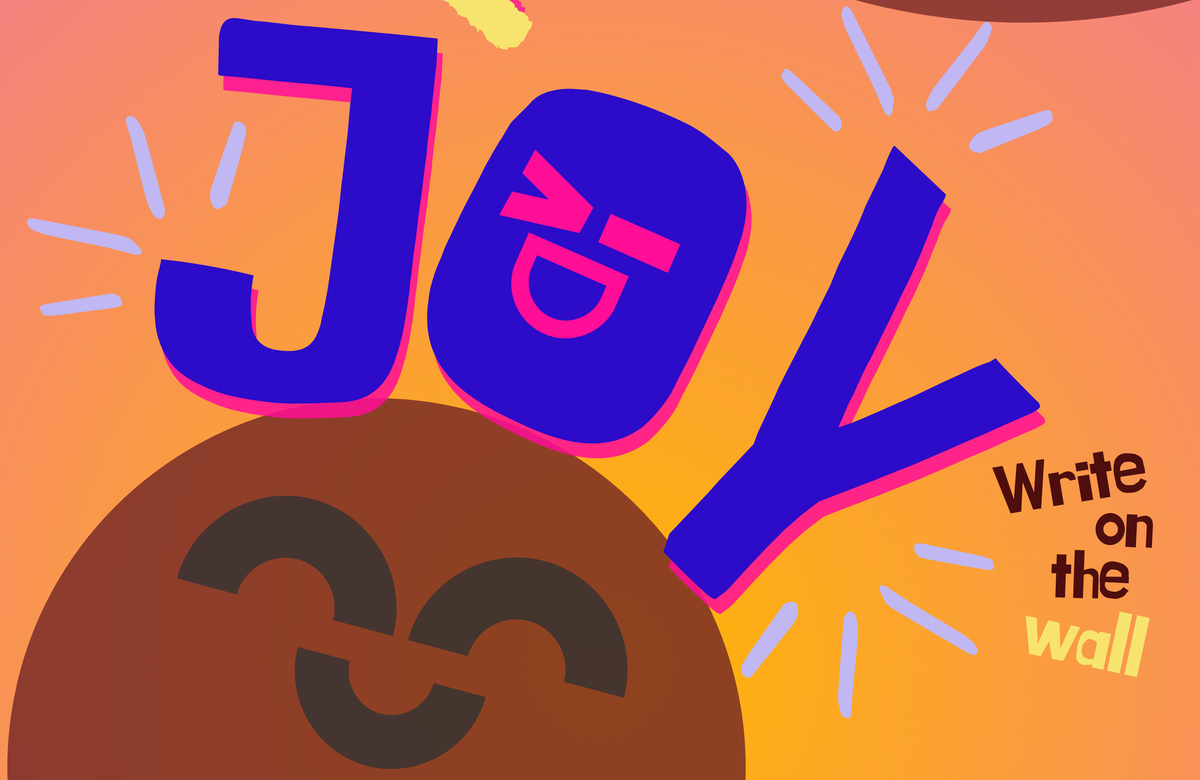
We're 65 hours into The Joy Index, and the thing I keep noticing is how differently research feels when it starts from experience rather than theory.
When students applied to be interns, we asked them to write about moments when learning felt genuinely joyful. Not to define joy, not to theorise it, just to tell us about a time when something clicked, when they wanted to be there. The stories they sent back were specific in a way that a framework never is. A lecturer who opened an accounting module by playing David Guetta at 10.30am, then told the room about his time at Vivienne Westwood, an act of self-disclosure that said: people like you belong here. A pharmacy practical built around a real patient scenario, where the work felt relevant and safe enough to think aloud. A coding problem that could only be solved collectively, the breakthrough arriving as a team rather than alone.
Joy is social. Joy happens when the world comes in. Joy often arrives in a collective moment, a shared click that you couldn't have had on your own.
You could list those as conditions: connection, relevance, belonging, collaboration. And we do work with that language. But the list doesn't carry what the story does. That's one of the things the first 65 hours have made clearer.
The Zine as Method
In our meetings, as we were working through what the research actually needed to do, the zine emerged. Six students — Mars, Ali, Milan, Ellie, Ellie-Mai, and Joy — took the moments they'd described in their applications and made them visible. As lived experience, rendered in their own words and their own aesthetic, laid out on a page that asks other students: what does joyful learning look like for you?
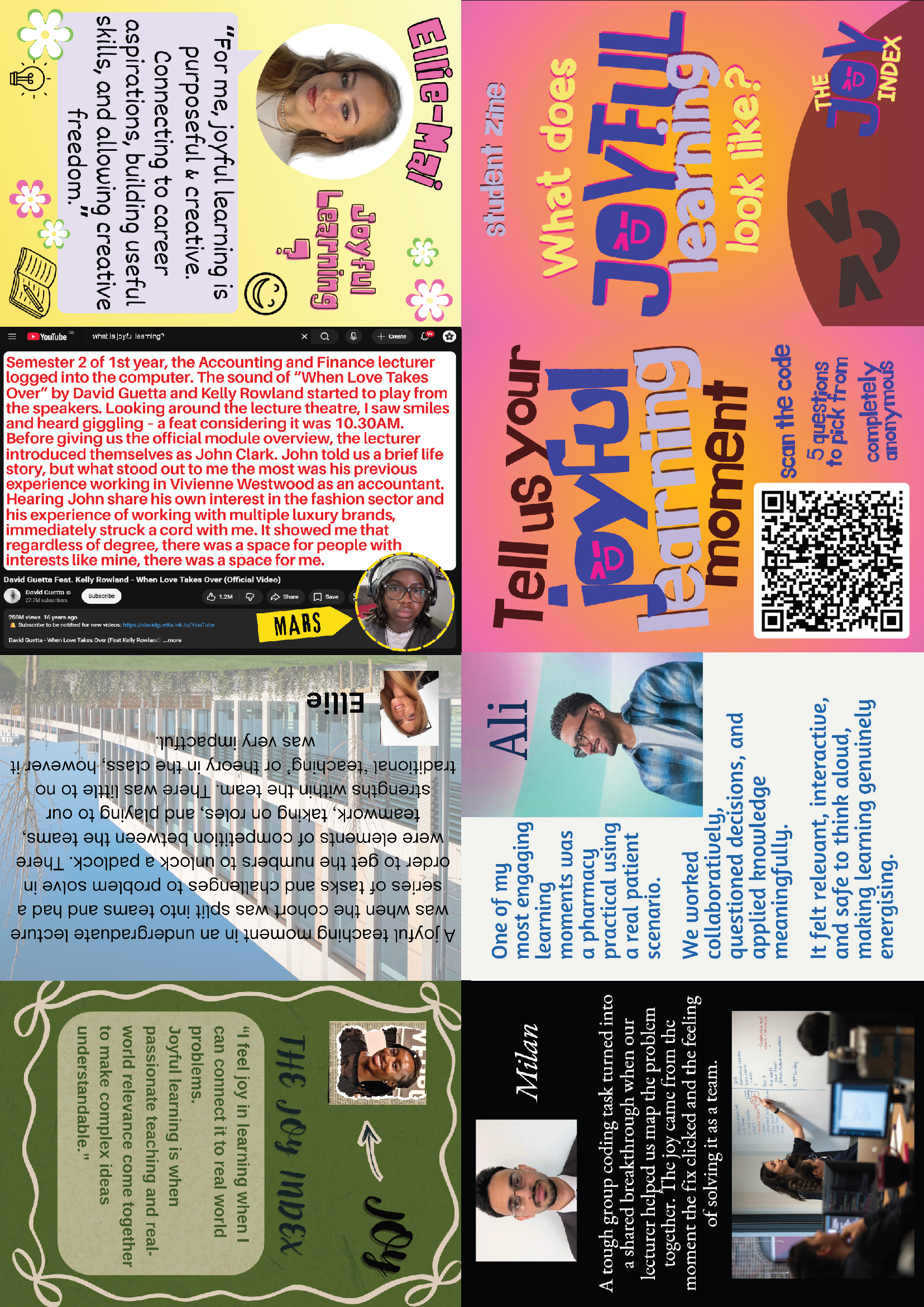
It would be easy to describe the zine as promotional material, something to get people interested in the project. But that misses what it's doing. The zine is methodology. It's a way of showing the research question rather than explaining it, and as I've written elsewhere, zines don't just present ideas differently; they generate ideas that prose can't quite reach. When students encounter it, they don't need to be told what intellectual joy is, or why it matters, or how it differs from engagement or satisfaction. They recognise it. They see a story and remember a lecturer who showed them something true about themselves. They read about the problem that took three people to crack and remember their own version.
From that same collaborative work, the banner came, the flyers, the pop-up materials. Before ethical approval had come through, before we could formally collect anything. Which is its own kind of finding. Research that begins with student stories, made by students, invites responses from students in a way that a survey link on a portal simply doesn't. The form of the invitation shapes what you get back.
What We're Starting to See
Ethical approval came through last week. We can now set up pop-up collection points in the Student Life Building, Redmonds, and James Parsons, and begin inviting students to share their own moments: a memorable class, a module you looked forward to, a time you lost track of time while learning, an assignment you genuinely enjoyed.
We've spent much of the 65 hours building shared language for what we're actually after. Working with LEGO, sharing experiences, sitting with the question of what intellectual joy actually looks like, rather than rushing to codify it. The conditions we identified in the original proposal, curiosity, challenge, creativity, connection, autonomy, and accomplishment, hold up. But what's becoming more interesting is how they work together, and how they fail separately. Challenge without connection is just difficulty. Autonomy without a reason to use it can feel like abandonment. Joy, it turns out, is rarely about one thing happening well. It's about several things happening at once, in the right proportions, for this particular student in this particular moment.
That's harder to design for than a framework suggests. It's also more interesting.
Where We Go From Here
The Joy Index starts from the belief that intellectually joyful teaching already exists at LJMU. The zine shows it. Six students found joy in their learning and made it visible through their own stories. Now we're asking where else it lives, what patterns emerge across disciplines, what the conditions are that teachers can actually work with.
By July we'll have the Joy Index Framework, an Atlas of Joyful Teaching with 12-15 case studies, and practical resources for colleagues. But the work of these early weeks has been about something more preliminary than outputs: finding a language for something that often goes unnamed, building the trust for students to say what actually matters to them in a learning environment, and working out how to make a research process feel as much like the thing it's studying as possible.
We're not there yet. But sixty-five hours in, the research is taking shape from the inside out, from stories, from collaboration, from what students already know, and that feels like the right place to start.
The Joy Index project runs January–July 2026 at Liverpool Business School, supported by LJMU's Curriculum Enhancement Internships scheme and UK and Ireland PRME Pedagogy Seed Funding.