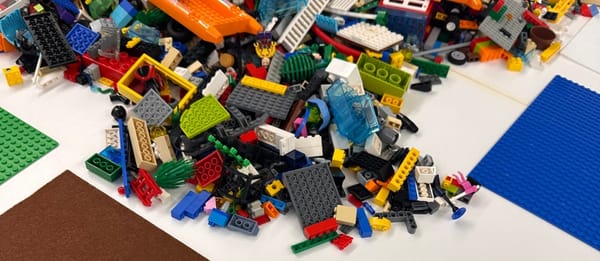
Room in the Bag of Stars: The Carrier Bag Theory of Management Education


What's In Your Bag?
I'm carrying two bags today. A Rough Trade tote with my planner, journal, pens, washi tape, stickers, headphones, a book, water bottle. And a large black leather tote with my laptop, keys, purse, clicker, and an embarrassing number of forgotten receipts, browning banana and sweet wrappers.
Neither bag is heroic. Neither tells a story with a clear beginning, middle, and end. They're just full of the stuff I need to teach, plus the stuff that accumulates when you're moving between rooms and responsibilities and never quite emptying out properly.
But Ursula Le Guin would recognise them.
In 1986, Le Guin wrote an essay called "The Carrier Bag Theory of Fiction." It's short, subversive, and quietly revolutionary. She argues that the first cultural device wasn't a weapon. It was a container.
Before the spear, before the knife, before all the tools designed to kill and conquer, humans made something simpler: a way to carry things home. A leaf, a gourd, a shell, a net woven from our own hair. Something to hold the gathered seeds, the collected berries, the small fry we needed to survive.
"If you haven't got something to put it in," Le Guin writes, "food will escape you – even something as uncombative and unresourceful as an oat."
The carrier bag, she argues, is the proper shape of human culture. Not the arrow's trajectory – starting here, going straight there, THOK, hitting its mark. But the bag: messy, full of things in relation to one another, holding beginnings without clear ends.
And yet we don't tell that story. We tell the hero story instead.
We tell the one about the mammoth hunters who came back with meat and ivory and a tale of conquest. We tell the one about thrusting spears into hairy flanks, about Oob impaled on tusks, about blood spouting in crimson torrents. That story has Action. It has a Hero. And before you know it, everyone else – the gatherers in the wild oat patch, the makers, the singers, the thoughtful ones – has been pressed into service in the hero's tale. But it isn't their story. It's his.
Le Guin isn't having it.
"I now propose the bottle as hero," she writes. And then, with characteristic wit: "Not just the bottle of gin or wine, but bottle in its older sense of container in general, a thing that holds something else."
She's serious. The novel, she argues, might actually be shaped like a sack, a bag. A medicine bundle holding things in powerful relation to one another and to us. Conflict might be one element in that bundle, but reducing all narrative to conflict is absurd. The purpose isn't resolution or stasis but continuing process.
"That is why I like novels," she writes. "Instead of heroes they have people in them."
I keep thinking about this when I teach.
Because business education is drunk on hero narratives. We teach case studies about visionary CEOs. We celebrate disruptors and innovators. We frame organisational life as competitive battlegrounds where leaders must conquer markets, crush competitors, drive growth. We treat profit as the finish line, the THOK that proves the arrow hit its mark.
Even when we teach "people practice" – which is supposed to centre humans, care, dignity – we often default to hero language. Strategic HRM. Talent management. Human capital. All those terms that turn people into resources to be optimised in service of someone else's conquest narrative.
I stand in front of students with my carrier bags and try to teach otherwise.
Not always successfully. Not always consciously. But increasingly, deliberately.
What if management education was carrier bag work? What if we stopped trying to create heroes and started teaching people to gather, to carry, to share, to make do?
What if we valued the daily work of organising care over the dramatic gesture of transformation? What if we celebrated maintenance over innovation? What if we admitted that most organisational life is beginnings without clear ends, missions that don't resolve neatly, people muddling through together?
My bags aren't a metaphor. They're just bags doing the work that bags do. But they're full of carrier bag pedagogy anyway.
The planner that helps me stay organised enough to create space for others. The journal where I process what's happening so I can teach more thoughtfully. The pens I'll lend to students who forgot theirs. The stickers that make planning feel less like management and more like care. The laptop holding seventeen drafts of module materials I'm still gathering, still refining.
And yes, the forgotten receipts. The sweet wrappers. The bits of paper with notes I can't decipher. Because carrier bag work isn't neat. It accumulates. It holds the intentional alongside the accidental.
Le Guin ends her essay by reimagining science fiction – and really, all serious fiction – as a way of describing what's actually going on. Not the mythology of conquest and apocalypse, but "what people actually do and feel, how people relate to everything else in this vast sack, this belly of the universe, this womb of things to be and tomb of things that were, this unending story."
There's room in fiction, she says, to keep everyone in their proper place in the scheme of things. Time enough to gather wild oats and sow them too, and sing to little Oom, and listen to Ool's joke, and watch newts. "And still the story isn't over. Still there are seeds to be gathered, and room in the bag of stars."
This is the permission I needed.
Permission to stop trying to make my teaching heroic. Permission to value gathering over conquering. Permission to tell different stories about what organisations are for, what management could mean, what economies might prioritise if we centred care and continuation over profit and growth.
Permission to teach otherwise.
Because the stories we tell matter. They shape what becomes thinkable, what seems possible, what we treat as inevitable or natural or just the way things are.
If the only story we tell about business is the hero story – the story of competition, disruption, exponential growth, winner-takes-all – then that's the world we'll keep making.
But if we tell carrier bag stories? Stories about gathering and sharing and maintaining and caring? Stories about continuing process rather than final triumph? Stories with people in them instead of heroes?
Then maybe we make different worlds possible.
This is the first in a series about storytelling, about joy and discomfort in learning, about the narratives that shape how we imagine what's possible. About teaching management education that doesn't just tidy up capitalism's conscience, but imagines something else entirely.
Le Guin gives us the shape for it. Not the arrow. The bag.
Messy, ongoing, full of things in relation. Room enough for wild oats and newts and forgotten sweet wrappers. Room enough for people doing the daily work of staying alive, staying human, staying in relation to one another.
Room in the bag of stars.